

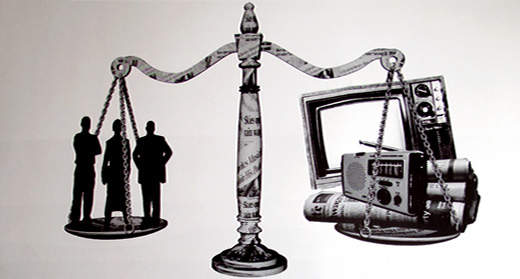
Media regulation poster from Zimbabwe
Building democratic resilience in the digital age, in Moldova and Ukraine: IMS’ high-level expert group releases a landmark report
Recommendations to support Moldovan and Ukrainian regulators and legislators in their efforts to advance democratic resilience in the digital age is here.
The recent parliamentary elections in Moldova have once again demonstrated how disinformation and foreign interference continue to challenge democratic processes across Eastern Europe and beyond. The digital environment has become a decisive arena for shaping public opinion, polarising societies and undermining trust in institutions, particularly in conflict settings or contexts marked by information manipulation.
Building democratic resilience requires multiple, complementary efforts – from strengthening independent media to developing regulatory frameworks that both protect freedom of expression and effectively address harmful and manipulative content. Among these frameworks, the European Union’s Digital Services Act (DSA) stands out as a reference point for balancing safety and rights in the online sphere.
“Moldova and Ukraine are now at the forefront of countries seeking to join the EU, which, among other things, entails the necessity of transposing the acquis into national legislation. The Digital Services Act and other norms of EU legislation are seen not only as a tool for taming the power of big tech, but also as a lever for the democratic development of both countries and a shield against Russian interference in local affairs through the use of online platforms. Despite Moldova’s preservation of its democratic track for the foreseeable future after the pro-EU party won the elections, it must secure its online space for the future, while Ukraine needs to be equipped for any post-war elections.”
– Maksym Dvorovyi, Senior legal council, Digital Security Lab Ukraine and High-Level Group Expert for Resilience Building in Eastern Europe Member
It is against this backdrop that IMS convened the High-Level Expert Group for Resilience Building in Eastern Europe (HLEG), bringing together experts from across the region and beyond – media regulators, digital rights advocates, journalists and policymakers – through a consultative process that included several in-person workshops held from Latvia to Austria and Denmark.
After a one-year process, the HLEG is releasing a landmark report to support Moldovan and Ukrainian regulators and legislators in their efforts to advance democratic resilience in the digital age.
“Our consultative process was undertaken with great care and thoroughness to incorporate the range of expertise in the group. This collaboration helped build consensus around the push for co-regulation in the digital spaces that safeguards freedom of expression.”
– Colette Simonne Wahlqvist, IMS Adviser and Head of the HLEG Secretariat.
The strength of this process lies in its deliberative nature, as members prioritised inclusivity and collective ownership to reflect the full range of perspectives and recommendations.
Providing concrete guidance for legislators and regulators in Moldova and Ukraine
This report, Recommendations for Moldovan and Ukrainian legislators and regulators for mitigating systemic risk – particularly during electoral periods, provides concrete guidance to help both countries navigate the complex intersection between technology, governance and democracy. It offers a roadmap for aligning national legislation with human-rights-based standards while developing strong and independent enforcement mechanisms.
Among its key recommendations:
- Establish independent platform regulators, inspired by the model of Digital Service Coordinators under the EU’s DSA, and adapted to each country’s institutional context and democratic needs.
- Foster bilateral cooperation between EU and candidate-country regulators to strengthen DSA-aligned enforcement and facilitate knowledge exchange.
- Encourage observer status for Moldovan and Ukrainian regulators in the European Board for Digital Services (EBDS) to support cross-border collaboration and shared learning.
“The work does not end here. These recommendations provide essential guidance for strengthening the information environment in Moldova and Ukraine, and they establish the foundation for the next phase of engagement. Online regulation is complex, particularly in the context of EU accession, and addressing these challenges requires sustained, forward-looking commitment. We are already moving ahead: in Phase 2, HLEG will shift toward practical, implementation-oriented support to help candidate countries and those adopting DSA-inspired legislation build resilient, rights-based digital ecosystems.”
– Gulnara Akhundova, Regional Director for Europe, IMS
The following steps now turn towards implementation and enforcement. Building on the frameworks proposed, IMS will continue supporting multi-stakeholder cooperation, fostering collaboration between emerging regulators in Moldova and Ukraine and their EU counterparts.
IMS’ work with the HLEG is supported by the Danish Ministry of Foreign Affairs.
HLEG membership:
• Guy Berger, Independent
• Pavlo Burdiak, Centre for Democracy and Rule of Law (Ukraine)
• Oleksandr Burmahin, National Council of Television and Radio Broadcasting, Ukraine
• Giorgi Davituri, Institute for the Development of Freedom of Information, Georgia
• Maksym Dvorovyi, Digital Security Lab, Ukraine
• Nino Macharashvili, ForSet
• Jason Pielemeier, Independent
• Eliška Pírková, who contributed to the HLEG during her tenure at Access Now
• Albertina Piterbarg, UNESCO
• Christoph Schmon, Electronic Frontiers Foundation
• Nina Shengelia, Social Media Council Georgia
• Elodie Vialle, Independent
• Liliana Vitu, Audiovisual Council, Republic of Moldova