


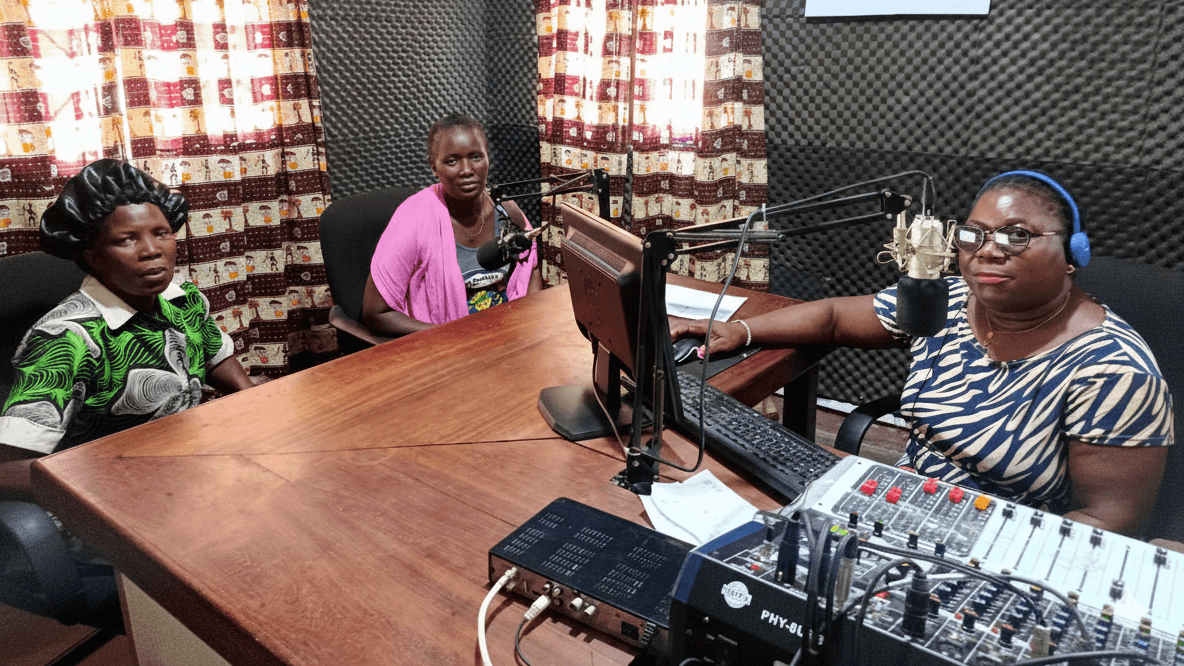
Judite Domingos interviews Jossefina Lavo and Luísa Fernando at Águia Radio in Mozambique. Photo: Maltez Mabuie/IMS
How community radio promotes rights awareness, social inclusion and public health of women in Mozambique
Women listening to the radio programme A Voz da Comunidade are using the information broadcast to improve their personal wellbeing and share knowledge in their communities.
In Dondo District, Sofala Province, access to credible, community-based information is generating tangible changes in the lives of women in vulnerable positions. Through the radio programme A Voz da Comunidade, broadcast by Águia Radio, a member of the Forum of Community Radio in Mozambique (FORCOM), women are strengthening their self-esteem, challenging social stigma and adopting practical behaviours that improve family health and wellbeing.
“Through A Voz da Comunidade, we want to ensure that women and families in our community have access to reliable information that helps them make better decisions about their health and wellbeing. With the support from IMS (International Media Support), we have strengthened our capacity to produce public interest programmes, engage more closely with our audience and improve the quality and reach of our content. The training and production grants have also helped us build a stronger and more sustainable radio station that truly serves our community,” said Judite Domingos, Interim Coordinator and Presenter at Rádio Águia.
Beyond individual agency, women are playing a central role by sharing information and as representatives of community transformation. The knowledge acquired through the programme does not remain at the level of individual listeners. It is shared within households, neighbourhood groups, savings associations, markets and other community spaces. Through this organic diffusion process, women extend the reach of each broadcast, reinforce positive social norms and contribute to sustainable behaviour change.
Jossefina Lavo, a person with a disability, faced years of discrimination and social exclusion within her community. This isolation significantly limited her participation in community life and affected her emotional wellbeing. After beginning to listen to the programme in early 2025, she was exposed to content addressing rights, social inclusion and stories of resilience. These messages contributed to restoring her confidence and strengthening her sense of voice. Today, she engages more actively in community discussions and encourages other women facing similar challenges to seek information and assert their rights.
Luísa Fernando encountered a different challenge. Her son showed severe signs of malnutrition, generating persistent concern within her household. Through the programme, she accessed practical guidance on child nutrition, including the preparation of enriched porridge using locally available products such as moringa. After applying the knowledge gained, she observed significant improvements in her child’s health. She subsequently began sharing this information with other mothers in her community, contributing to improved nutrition practices beyond her own family.
Their shared testimony encapsulates the programme’s impact and reflects the broader role of community radio as a platform for knowledge, dialogue, and social transformation:
“Through the programme A Voz da Comunidade, we have gained the skills to confront social stigma and improve the health of our families,” said Jossefina Lavo and Luísa Fernando, whose experiences illustrate how community radio can support both social inclusion and improved family health.
This experience illustrates two interlinked dimensions of change:
- Individual empowerment and reduced stigma.
- Adoption and multiplication of practical health and inclusion practices at community level.
More broadly, it demonstrates how community radio goes beyond information dissemination. By providing accessible, locally relevant and rights-based content in local languages, radio becomes a trusted public space where women receive, internalise, apply and share knowledge. In rural and peri-urban contexts, where access to specialised services and diversified information sources remains limited, community radio plays a strategic role in promoting rights awareness, social inclusion, public health and civic participation.
The programme A Voz da Comunidade is implemented under the project “Safeguarding and Strengthening Local and National Public Interest Journalism in Mozambique”, funded by the European Union and delivered by a consortium comprising FORCOM, Mídia Lab and MISA Mozambique, under the coordination of IMS.
Beyond content production, the project has strategically invested in strengthening the technical and financial capacity of 20 community radio stations distributed across nine provinces of Mozambique. This support enhances institutional sustainability, improves editorial and operational standards and reinforces their ability to consistently produce high-quality public interest content and serve as trusted local information platforms.
By simultaneously supporting women in their role as sources of information and strengthening community radio institutions as pillars of public interest journalism, the initiative contributes to building more informed, inclusive and resilient communities, where information does not merely circulate, but drives measurable and lasting social transformation.