

Freedom of expression in the wake of Ukraine’s EuroMaidan
By Stephanie Schoenhoff, Canadian Journalists for Free Expression
While Ukraine has long suffered from a dominant culture of impunity and corruption, the country has seen an accelerated onslaught of attacks against journalists as well as threats to freedom of expression in recent months.
The threat of draconian media crackdowns has, for the time being, subsided in Ukraine, says Antonina Cherevko, IMS’ Programme Manager for Ukraine. Since the previous president, Viktor Yanukovych, was ousted on 22 February 2014, “the climate [for free expression] at the government level is of course much better,” she says.
On the governmental and legislative levels, it appears as though freedom of expression is growing in priority. “We [in Ukraine] have two very good laws which were recently adopted by the transitional government,” says Cherevko. The first was a new public service broadcasting law, which indicates the government’s eagerness to institutionally secure media pluralism in Ukraine. In response to Ukraine’s state-controlled media which privileged the ruling elite under Yanukovych, this new law will require state broadcasters to undergo the reform process in order to be transformed into genuine public service broadcasters.
The second law seeks to expand the right of every person to access public information being held by the government or government agencies. While the Ukrainian government initially adopted access to information legislation in 2011, it lacked certain enforcement mechanisms and was also limited by other Ukrainian legislation that prevented it from working. The new amendments to the access to information laws, adopted in March 2014, introduce fines for failing to respond to a request as well as a number of other measures that increase the efficacy and efficiency of the laws. The aim of the law is to further increase the transparency and openness of the Ukrainian government.
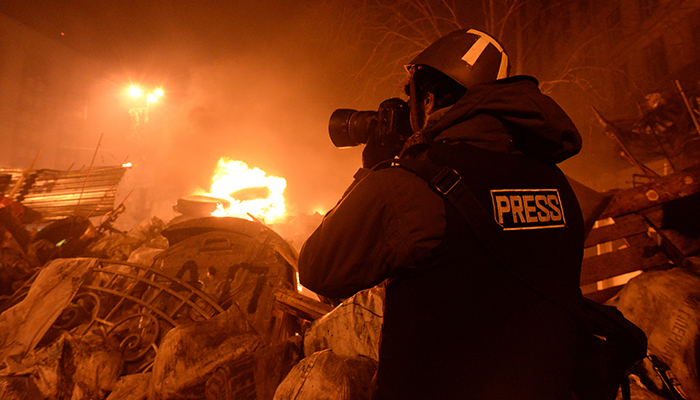
This is a huge step forward from 17 January 2014, when Yanukovych passed into law strict anti-demonstration laws as a response to protesting EuroMaidan citizens who had been demonstrating in Kyiv since November 2013. The laws were quickly deemed draconian and spurred heightened demonstrations in Kyiv which eventually turned violent. During the intensification of the protests, attacks on the media were particularly frequent. “They were attacked before, many times. But after the escalation, journalists were specifically targeted by riot police,” says Cherevko.
The escalating protests, and the response from the international community, led the Ukrainian government to retract the bill on January 28th, 2014. Despite the retraction, unrest continued and Yanukovych fled the country on February 21; he was voted out of Parliament the following day.
Though the ousting of Yanukovych was a positive step for freedom of expression, it is clear that the months since his departure have nevertheless been dangerous in certain parts of Ukraine. The results of the conflict surrounding the annexation of Crimea, and the Russian militant presence in the east, have been devastating. The international community has anxiously monitored the rising death tolls as both international and local journalists are kidnapped, killed and attacked.
Recent examples of violence against the press in the eastern part of the country include, 15 cases of attacks against and captures of mass media offices and TV broadcasting towers since the beginning of March, at least five journalists in Crimea and mainland Ukraine detained by Russian authorities, and an attack on a local newsroom in eastern Ukraine.
Countless other threats and attacks have been reported by the Ukrainian non-governmental group, Institute for Mass Information, showing the region’s rapidly deteriorating climate for freedom of expression. The US-based Committee to Protect Journalists (CPJ) has documented a similar frequency of threats, attacks, detentions and abductions of journalists in eastern Ukraine.
Due to the incredibly challenging political environment, the media in Ukraine has taken on many structural and cultural changes, including a diversification of news outlets and reporting. “One of the changes that the EuroMaidan protests brought into Ukraine is a switch from TV to Internet as a source of news,” says Cherevko. “During the protest there were several fantastic independent media initiatives that were launched, and covered the protest,” says Cherevko. Some of these projects include Spilno TV, Hromadske TV, and Hromadske Radio. The first two initiatives conducted live streaming of the protests and live reporting.
Commenting on the future of press freedom under President Petro Poroshenko, Cherevko says that she is “confident Poroshenko will demonstrate that he supports democratic ideals, including freedom of expression,” She did warn, however, that he is the owner of the television news broadcaster Channel 5. Before the elections, Poroshenko made a promise that he was going to sell all of his businesses should he be elected as President; however, Poroshenko now says that he is not going to sell Channel 5, but that the channel will “keep its editorial independence.”
With regards to whether the climate for corruption in the media will improve, Cherevko says that it will be measurable by whether Poroshenko intrudes on the editorial policy of Channel 5 in the coming months. “Overall his government should be open to cooperation with civil society,” predicts Cherevko.
Ultimately, Cherevko says that there are ‘two sides of the coin’ in the situation for journalism in Ukraine. “One side is obviously that we have dramatic rates and scores of journalists being beaten, injured, assaulted in many different ways,” But the other side of the coin is that, “many really creative, new media initiatives [were created]. We have a raised interest in the Internet, and media literacy is also steadily improving among the population.”
As the conflict in the east prevails, violence against journalists continues to reign. Albeit fledgling, progress in freedom of expression in most areas of the country does seem to give us reason to be cautiously optimistic about the future for press freedom in the whole of Ukraine. At the very least, it is clear that civil society has taken impunity and corruption into their own hands by starting new media initiatives and pushing for press freedom in the law and practice. However, until every journalist feels safe reporting in Ukraine, there is more to be done to fight for this issue.
This article was adapted and republished from Ukraine: Free expression in the wake of EuroMaidan, courtesy of Canadian Journalists for Free Expression