

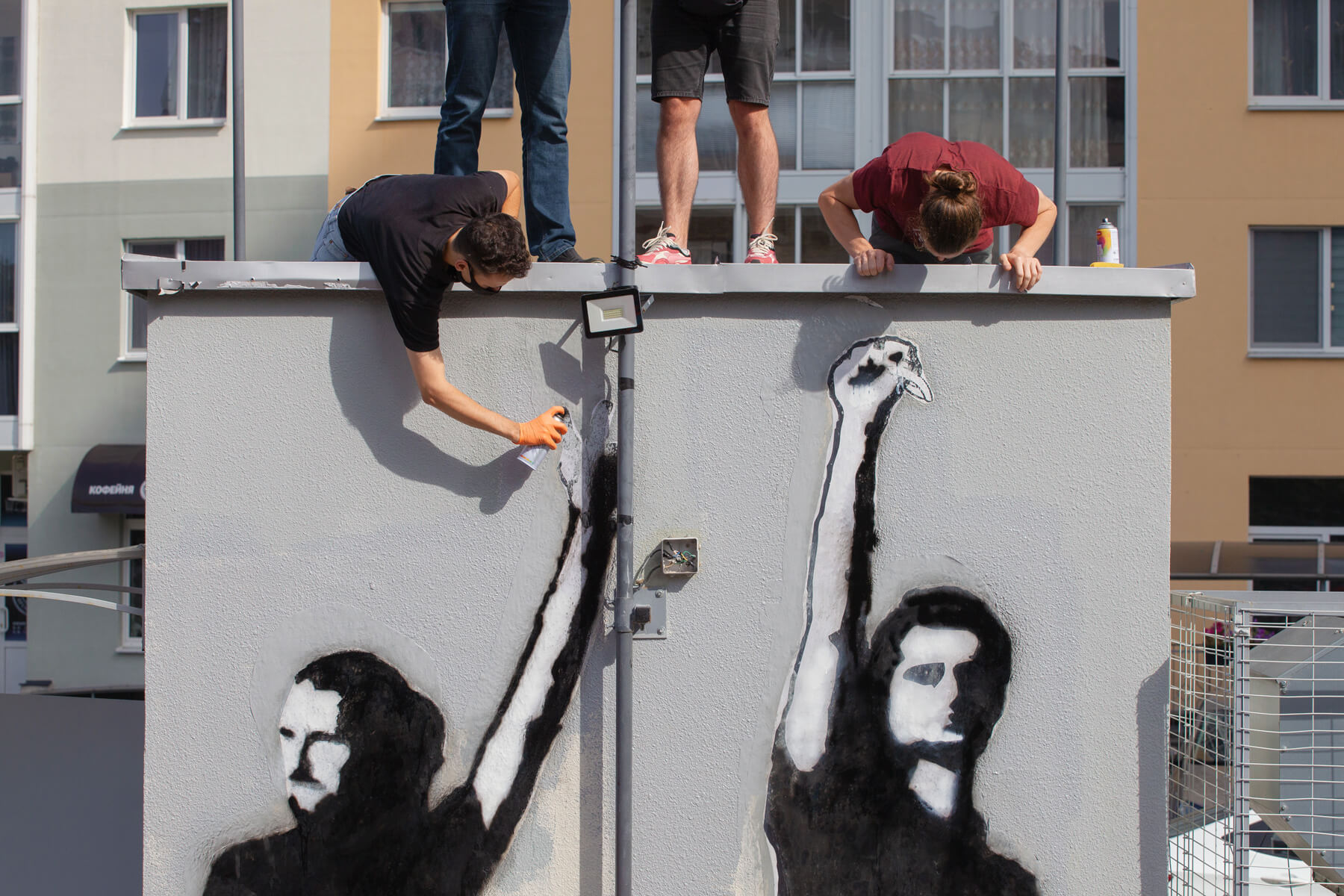
Locals restoring the mural in the Square of Change in Minsk, Belarus, on 3 September 2020 after yet another attack by unidentified vandals.
Unlocking local capital
Solidarity between media and exiled business from Belarus for new capital
Belarusian independent media-in-exile face a unique financial crisis that goes far beyond typical nonprofit sustainability challenges. Could a mapping of untapped resources in the business diaspora be a first step forward?
This is an abstract from the April 2026 release of Unlocking local capital.
The daily operational pressures on journalism in a hostile environment – often perilous on-the-ground reporting, newsroom management, and the pressures of paying staff – leave little capacity to adjust to restrictive legislation or develop new strategies for sustainability. Also, direct funding from IMS or other foreign entities would place newsrooms at significant legal risk.
Belarusian independent media-in-exile face a unique financial crisis that goes far beyond typical non-profit sustainability challenges. Cut off from their home country since 2020, these outlets face two challenges: their mission has never been more critical, yet their traditional revenue models have completely collapsed. The Belarusian business diaspora has significant potential for mobilising resources towards media. It is comprised of successful entrepreneurs, many of whom relocated their operations to avoid regime pressure. They have significant resources, yet minimal efforts have been made to unlock these for the benefit of independent media.
As grant funding, of the sort independent Belarusian media rely on, becomes increasingly precarious, the result is inevitable: staff cuts, reduced output, and shutdowns. Competition for remaining funds is fierce, with dozens of Belarusian civil society organisations competing for the same limited pools of money. In addition, grants are often short term with media devoting much time and resources to fundraising cycles, which limits their ability to focus on journalism that requires long-term editorial planning, such as investigations.
The numbers tell a stark story. Before 2020, leading Belarusian independent media derived 40-60 percent of their budgets from advertising, subscriptions, and events. Today, these sources have almost disappeared. Audiences access content through virtual private networks (VPNs) from inside Belarus, making subscription collection difficult. The diaspora, while supportive, is small and scattered across dozens of countries, i.e. simply not coherent enough to sustain a professional media ecosystem. Events and advertising, once reliable income streams, are difficult to scale, when teams are distributed across Warsaw, Vilnius, Prague, and beyond.
“We’ve managed to rebuild about 40 percent of self-financing through diaspora support and community donations, but the diaspora is simply not big enough to sustain professional journalism long term. Grant funding is shrinking – USAID is essentially gone, European programmes come and go – and when you don’t know if you’ll have money in six months, you can’t plan, you can’t keep your best people, you can’t invest in quality. You just survive.” Belarusian media leader
The Belarusian business diaspora represents a largely untapped source of capital for a number of reasons. Firstly, it is dangerous for expatriates to support any media outlet that the regime back home has labelled ‘extremist’. Fear of retaliation for such support is real, especially since many business owners still have operations or family members in Belarus. Others are simply overwhelmed by requests from the hundreds of Belarusian NGOs and other initiatives now in exile, with media rarely a priority. Also, a resistance to short-term, stop-gap funding, and the lack of clear impact metrics, combine to weaken any outreach vis-à-vis private philanthropy and impact investors.
An endowment fund of some sort could address these structural problems. As a first step, establishing such a fund would require a feasibility study. Instead of asking businesses to fund media operations directly, an investment vehicle that generates returns could set up a ‘firewall’ between donations and media. The goal would be to design a mechanism that could generate baseline support for multiple media to rely on, i.e. an exile business community that is supporting exile media, united by the ambition to reconnect and, eventually, reshape Belarus? In this case, a feasibility study, once seed-funded, could review best-fit entry points.
“There are Belarusian businesses for whom one-time support to different projects is not enough. It is important for them to invest in long-term processes, to leave their mark, and contribute to the process of democratic change in Belarus over the long haul.” Belarussian business leader
IMS’ view: Saving independent journalism is a strategic, logistical, and legal challenge. Navigating the legal landscape is a crucial skill for this approach: we must review how authorities classify revenue streams, anticipate reclassification, and develop mitigation strategies. While there is no silver bullet, a combination of measures – mixing domestic private investment, structured market-based commercial activities, and robust legal shielding – can create the necessary buffers. By de-risking the financial ecosystem and reducing reliance on revenue that might be subject to the increasingly toxic ‘foreign grant’ label, media organisations can move from a state of constant vulnerability to one of strategic resilience and tactical agility.