


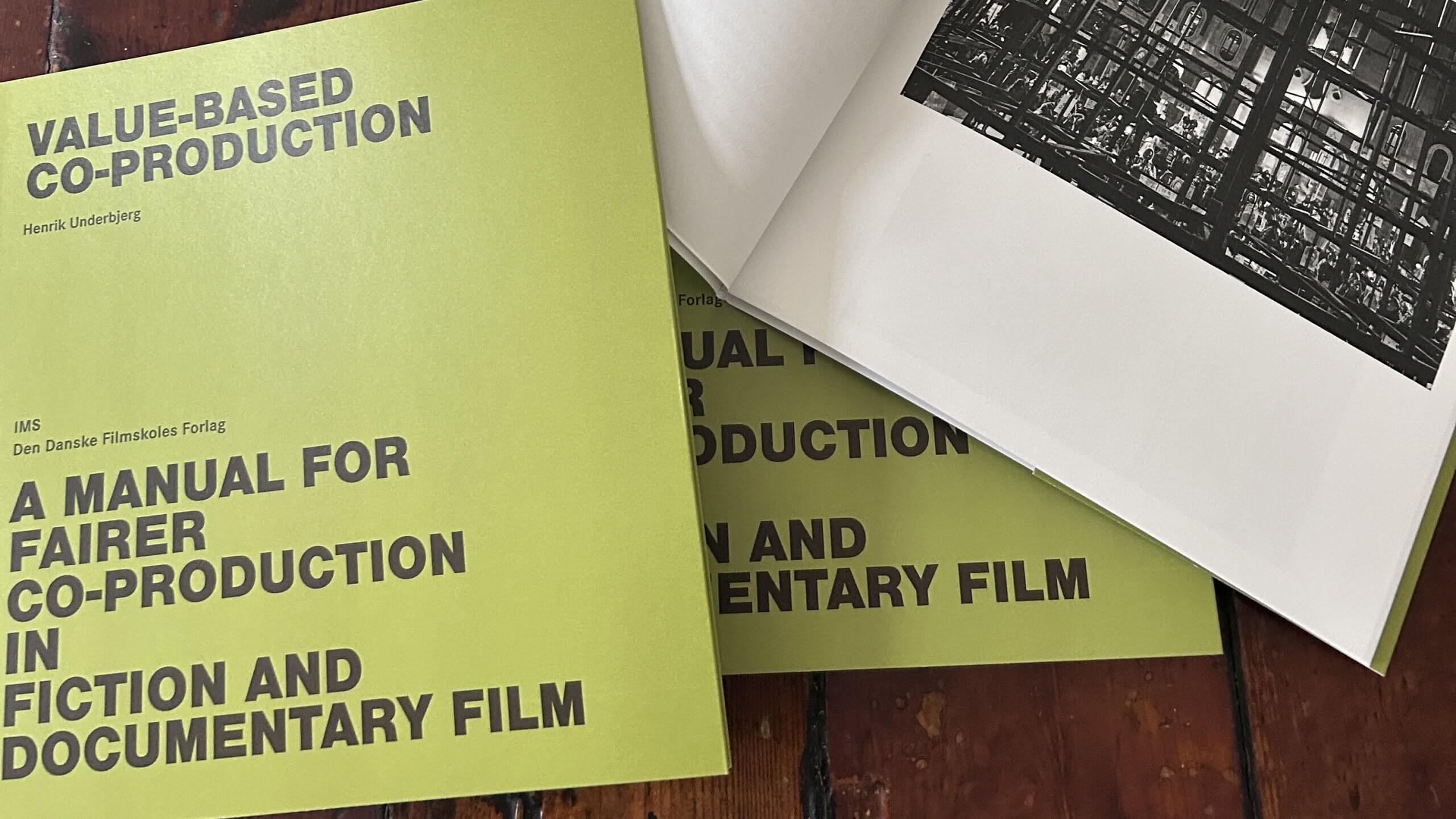
Value based co-production in fiction and documentary film manual, produced by IMS and The National Film School of Denmark (Photo: IMS).
Redefining value in documentary film production
IMS is launching a new model for the international co-production of fiction and documentary film
IMS has published a manual for value-based co-production which will be launched at the Ukrainian film festival Docudays UA in Kyiv.
The manual was developed over several years through discussions with producers, legal experts, funders, broadcasters, training institutions and film organisations across the documentary sector. It has been shaped by practical cases, institutional dialogue, advocacy, an international task force and wider sector reflections through the 2025 EAVE Think Tank. It includes a preface written by Fabrice Puchault, Head of Society and Culture Department, ARTE France.
The approach applies to both fiction and documentary film, but its relevance to IMS is clearest in documentary, where questions of ownership, authorship, access and public-interest storytelling are closely connected.
A structural problem in international co-production is addressed in the manual: rights and future revenues are often divided according to the financing each co-producer brings to the budget. In countries with comparable production economies, this can work. But when films are co-produced between high-cost and lower-cost production environments, the model can convert differences in cost level into differences in ownership.
That matters.
IMS works with documentary film, and many of these films would not exist without international co-production. This is especially true in countries where national financing is limited, politically exposed or difficult to access. Co-production allows films to cross borders, gather resources, reach audiences and enter international markets.
The current structure can weaken the environments from which the films emerge
A producer may carry the original idea, access, development, language, trust, risk and relationship to the reality being filmed. The film may depend on precisely those contributions. Yet, if rights are divided mainly according to currency spent, a co-producer from a higher-cost country can end up with a larger ownership share because their contribution is more expensive – not necessarily because it is more valuable to the film.
The result is often not exploitation by intention. It is a structural habit. But the consequence is clear: value created in one place can be converted into rights elsewhere.
Value-based co-production proposes another starting point. It does not impose a fixed formula, and it does not replace the free negotiation between co-producers. Rather, it offers an argument and a practical framework for asking whether rights and receipts can follow the value each party brings to the film, rather than only the cost of each party’s contribution. The approach does not reject co-production, financing, treaties or institutional frameworks. It uses the legal framework that already exists: the Council of Europe framework requires rights and clauses on receipts or territories but does not require them to follow financial investment one-to-one.
The potential impact is significant
Documentary has become central to the battle of the narrative. Not because it stands outside politics, but because it gives reality a form that can travel. It can turn local experience into public evidence, connect individual lives to systems of power and make social and political conditions visible across borders.
This is also why documentary is often vulnerable in the countries where IMS works. The films can be too precise, too recognisable, too capable of reaching national audiences with stories that disturb official narratives or expose the gap between power and lived reality. They may not need mass reach to matter. They need to find the right audiences, at the right moment, with enough force to shift understanding, sustain public memory or create pressure.
If documentary is part of the battle of the narrative, then the ownership structures behind documentary are also part of that battle.
In practice, this can shift money, rights and negotiating power back toward the producers and production environments where the films are conceived, developed and borne. That can strengthen companies, talent bases, editorial capacity and the ability to make the next film. In other words, the impact is not only a fairer contract. It is stronger documentary ecosystems in places where independent public-interest storytelling is under pressure.
The model sits centrally within IMS’ mission
IMS works to strengthen enabling environments for public interest media. Documentary belongs inside that mandate when it documents realities, challenges power, reaches audiences and helps societies understand conflict, repression, corruption, reform or democratic change. Documentaries are a tool for change.
The conditions under which such films are financed, owned and circulated are therefore not separate from the media environment. They shape who can keep working, who can build companies, who can retain rights, who can negotiate the next film and who remains dependent on external structures.
Value-based co-production is not a technical correction to film contracts. It is a practical model for making international cooperation strengthen the environments it depends on.
Co-production makes films possible. Value-based co-production asks whether the films can be made without weakening the places they come from.